


Toronto is one of Canada’s most active business hubs, with industries that depend on technology to keep operations moving every day. From finance and healthcare to manufacturing and professional services, the city’s economy runs on connected systems, secure data, and reliable support.
That growth isn’t slowing down. Toronto’s GDP reached $213.5 billion in 2023, with projections pointing to 2.9% annual growth from 2025 to 2028.
As Erez Zevulunov, CEO of M.I.T. Consulting, puts it: “As Toronto businesses grow, IT can’t be the thing slowing them down. It needs to be stable, secure, and easy to manage.”
In this article, we’ll break down the top Toronto industries, the technology challenges they face, how businesses are adapting, and the practical ways managed IT services support long-term stability, security, and growth.
The Top Industries in Toronto Driving the Economy
Toronto’s strength comes from its mix of industries — and that balance helps the city stay competitive even during uncertain economic cycles. Here are some of the most influential sectors shaping the Toronto market today.
1. Financial Services
Toronto is Canada’s financial capital, home to major banks, insurance providers, investment firms, and fintech companies. This industry relies heavily on secure networks, controlled access to sensitive information, and systems that remain available without interruption.
For financial organizations, even small technology gaps can create serious business risks, especially when client trust and regulatory expectations are on the line.
2. Professional Services (Legal, Accounting, Consulting)
Professional services firms run on secure communication and fast access to documents. Legal and accounting teams, in particular, depend on email security, protected file storage, reliable remote access, and consistent device performance.
When your work revolves around confidential client data, your IT environment can’t be improvised. It needs structure, monitoring, and strong security standards.
3. Healthcare, Dental Clinics, and Medical Practices
Toronto has a growing healthcare ecosystem that includes hospitals, clinics, dental offices, and specialized practices. These organizations depend on technology to manage scheduling, records, billing, and daily operations.
Healthcare environments also face strict privacy expectations and increasing cybersecurity threats. When systems go down or data becomes inaccessible, it doesn’t just slow work — it can disrupt patient care.
4. Manufacturing and Industrial Operations
Manufacturing remains a major part of the GTA economy, especially across industrial and commercial sectors. These organizations often rely on a mix of traditional infrastructure and modern cloud systems, with uptime and reliability as constant priorities.
Even when a company isn’t “tech-forward” on paper, its production output often depends on stable connectivity, secure networks, and responsive IT support.
5. Construction, Engineering, and Real Estate
Toronto’s growth drives constant demand for new builds, renovations, infrastructure projects, and commercial development. Construction and engineering teams rely on collaboration tools, job-site connectivity, mobile devices, and file sharing to keep projects moving.
When technology fails in these environments, it can lead to delays, rework, missed updates, and major coordination problems between teams.
6. Retail, Hospitality, and Multi-Location Businesses
Retailers, hospitality groups, and multi-site operations need technology that performs consistently across every location. This includes point-of-sale systems, guest Wi-Fi, inventory tools, staff devices, and payment security.
The more locations you operate, the more endpoints you manage — and the faster issues multiply when IT support isn’t standardized.
Not Sure What Your IT Priorities Should Be?
We’ll help you identify gaps, reduce risk, and build an IT roadmap that fits your business.
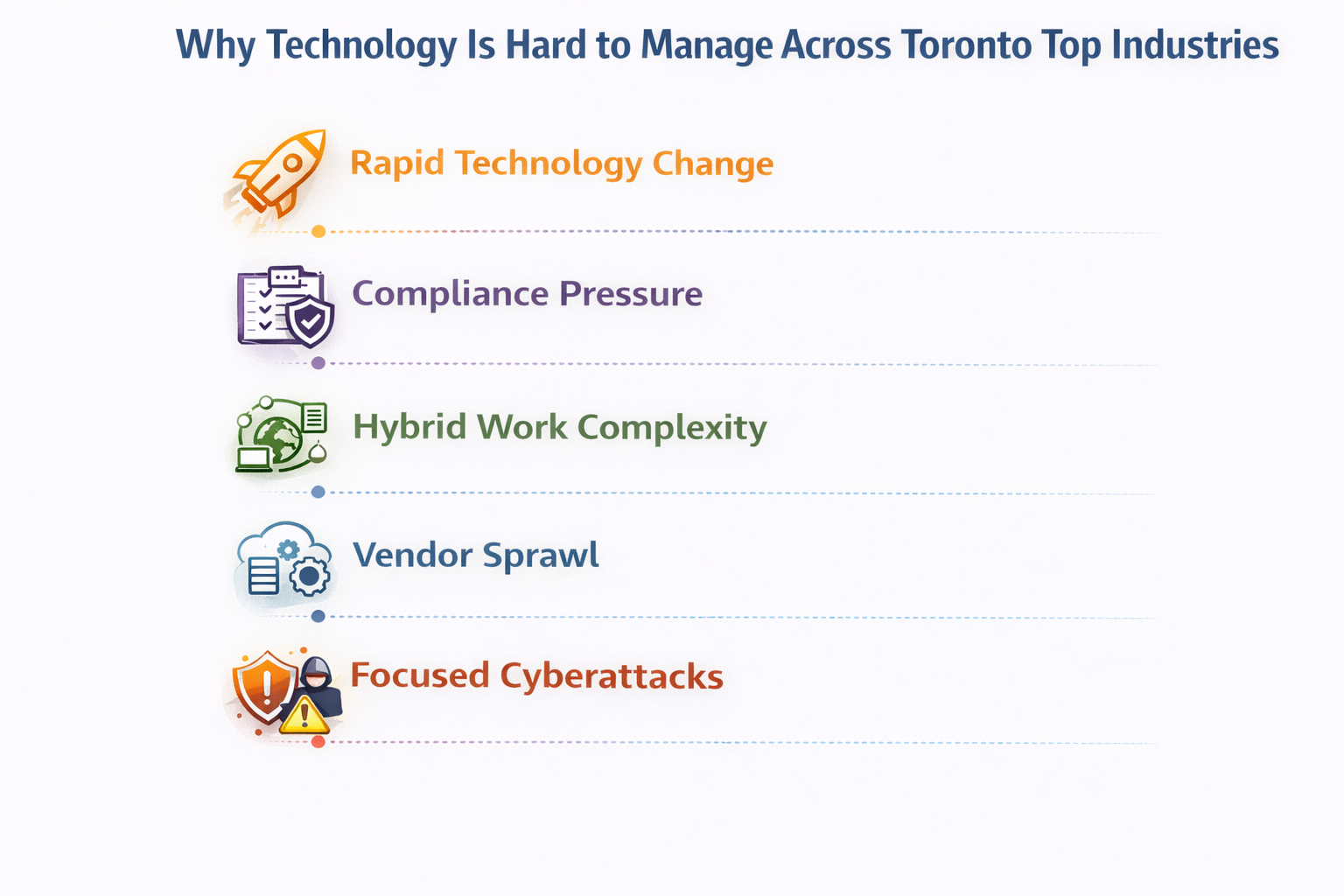
Why Technology Is Hard to Manage Across Toronto’s Top Industries
No matter the industry, most Toronto organizations are dealing with similar IT pressure points. Modern technology changes quickly, and business expectations change even faster.
Here are some of the most common challenges we see across Toronto:
Rapid technology change
Businesses are expected to keep up with evolving platforms, security threats, and productivity tools — without slowing down operations to “catch up.”
Compliance pressure and higher client expectations
More organizations are being asked to meet stricter cybersecurity and privacy requirements, including expectations tied to PIPEDA, PCI, and emerging certification frameworks.
Hybrid work and multi-location complexity
Many teams now operate across multiple offices, job sites, and remote environments. That creates more devices, more access points, and more risk if security isn’t managed properly.
Vendor sprawl and fragmented IT management
When different providers handle hardware, cloud platforms, security tools, and support, the result is often inconsistency. That makes troubleshooting slower and accountability unclear.
Cybersecurity threats that don’t discriminate
It’s no longer just “big enterprises” being targeted. SMBs and mid-market organizations are constantly exposed to phishing, credential theft, ransomware, and business email compromise. And according to CloudSecureTech, 88% of all data breaches are caused by employee mistakes, which makes security awareness and day-to-day IT controls just as important as the tools themselves.
 How the Biggest Industries in Toronto Are Adapting to Digital Change
Toronto is on a strong long-term growth trajectory. In fact, the city is on track to double its GDP in 25 years, with an estimated 50% increase in GDP per capita along the way.
To keep pace, organizations across industries are modernizing their IT environments in practical ways, including:
-
Standardizing collaboration tools through Microsoft 365 or Google Workspace
-
Moving toward cloud-first infrastructure to support scale and flexibility
-
Investing more in cybersecurity monitoring and incident readiness
-
Building stronger backup and disaster recovery planning
-
Exploring productivity improvements through Microsoft Copilot and Gemini
This shift isn’t about chasing trends. It’s about building IT systems that can support growth without becoming fragile, expensive, or reactive.
How Managed IT Supports Industries in Toronto
|
Business Need |
Common Toronto Industries |
Where Managed IT Helps Most |
What You Gain |
|
Security + compliance readiness |
Financial services, healthcare, legal, accounting, nonprofits, local government |
Identity and access controls, endpoint protection, monitoring, policy alignment, audit preparation |
Lower cyber risk and stronger compliance posture |
|
Uptime for revenue-critical operations |
Manufacturing, industrial, logistics, retail, hospitality |
Proactive monitoring, network stability, patching, incident response planning |
Fewer disruptions and more predictable operations |
|
Support for multi-location or hybrid teams |
Construction, engineering, real estate, professional services, education |
Secure remote access, cloud collaboration, device management, standardized tools |
Consistent performance across offices, sites, and remote work |
|
Vendor and system consolidation |
Growing SMBs and mid-market organizations across sectors |
One accountable partner for hardware, cloud platforms, cybersecurity, and support |
Less complexity and clearer accountability |
|
Strategic guidance for growth |
Mid-market firms, fast-scaling organizations, internal IT teams needing support |
IT roadmaps, risk reviews, lifecycle planning, fractional CIO support |
Better decisions, fewer surprises, and IT that scales with the business |
What to Look For in a Toronto Managed IT Partner
If your industry depends on technology to operate, the right IT partner should help you build long-term stability — not just fix issues after they happen.
Look for a provider that can deliver:
-
Managed IT and project support, not just ticket-based troubleshooting
-
Cybersecurity and compliance guidance, not security as an add-on
-
One accountable partner across infrastructure, cloud, and security
-
Advisory support that connects IT decisions to business outcomes
-
Flexible support hours, based on your operational needs
Toronto businesses don’t just need “IT support.” They need a technology partner that can keep systems stable while helping them scale with confidence.
More articles you might like:
Choose an IT Partner That Supports Your Toronto Industry End-to-End
M.I.T. Consulting is a long-term managed IT and advisory partner for Toronto and GTA businesses. We support SMBs and mid-market firms that need stable operations, strong security, and guidance that ties technology decisions to business outcomes.
Whether you need a full IT department or co-managed support alongside internal teams, M.I.T. Consulting provides the coverage to keep your business moving forward.
You can work with us for:
-
Managed IT services
-
IT support and helpdesk
-
Cybersecurity and compliance support
-
IT consulting and fractional CIO services
-
Network support
-
Microsoft 365 and Google Workspace migrations and optimization
Reach out to M.I.T. Consulting to discuss your industry, your current IT environment, and what reliable, scalable support should look like for your business.