

Table of Contents
-
Why Outsource IT Infrastructure When Growth Adds Operational Pressure
-
IT Infrastructure Outsourcing And The Systems Leaders Need Under Control
-
Infrastructure Outsourcing For Smaller Teams Without Internal IT Depth
-
Outsourcing Your IT Infrastructure While Keeping Internal Teams In Control
-
Building An Outsourced Infrastructure Model That Supports Scale
Support tickets, onboarding delays, Microsoft or Google administration, backup readiness, cyber insurance questions, and vendor coordination all land somewhere. Without a clear IT owner, they land on managers who already have approvals, invoices, employees, and customers to handle.
That is why leaders ask why outsource IT infrastructure as an operating decision, not just a technical one. IT infrastructure outsourcing helps growing organizations protect uptime, standardize access, and improve leadership visibility without adding unnecessary internal headcount. Managed services spending rose to 18% of IT budgets in 2023.
Michael Fin, CTO at MIT Consulting, notes: “Stable infrastructure gives leadership fewer surprises, cleaner decisions, and a clearer view of where support delays, security gaps, and system costs are actually coming from.”
Why Outsource IT Infrastructure When Growth Adds Operational Pressure
Infrastructure strain usually appears first in repeated problems: recurring user issues, slow approvals, inconsistent laptop standards, and unclear ownership when a firewall vendor, software provider, and internet carrier all touch the same incident.
-
Recurring support queues: The same printer, VPN, or mailbox ticket keeps returning because no one has traced the root cause across devices, permissions, and network settings.
-
Messy user changes: New hires wait for Microsoft 365 or Google Workspace access, while departed users keep shared drive permissions longer than they should.
-
Security and backup gaps: Backup alerts, endpoint warnings, and policy exceptions sit unread, which affects customer trust when clients ask how data is protected.
-
Limited leadership visibility: IT invoices, renewals, licensing, and risk items appear as scattered costs rather than a managed plan. Cost reduction is the most cited driver for software development outsourcing at 63%, but leadership still needs control, not just savings.
These symptoms point to a management model issue. Our assessments start with workflows, ownership, budget fit, and risk before we recommend tools.
IT Infrastructure Outsourcing And The Systems Leaders Need Under Control
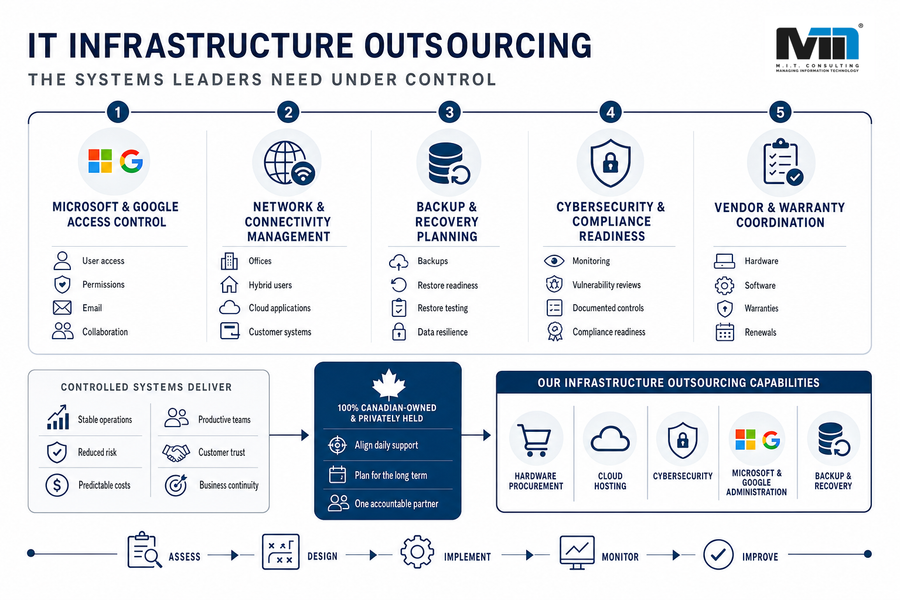
Infrastructure is more than servers and networks. It includes the everyday systems that determine whether work moves cleanly.
-
Microsoft and Google access control: User access, permissions, email, and collaboration settings need consistent administration. A finance folder shared with the wrong group creates both a workflow issue and a data exposure issue.
-
Network and connectivity management: Offices, hybrid users, cloud applications, and customer-facing systems depend on stable connectivity. A slow point-of-sale terminal or unreliable video call becomes a business interruption.
-
Backup and recovery planning: Invoices, client records, shared files, and line-of-business data need recoverable backups, not assumptions. Restore testing matters before a server failure or accidental deletion.
-
Cybersecurity and compliance readiness: Monitoring, vulnerability reviews, and documented controls protect customer data and support contract eligibility.
-
Vendor and warranty coordination: Hardware, software, warranties, and renewals need one organized view. Fragmentation adds risk when approvals, repairs, or replacements stall.
As a 100% Canadian-owned and privately held partner, MIT Consulting reduces that fragmentation by aligning daily support with long-term planning.
Hardware procurement, cloud hosting, cybersecurity, Microsoft and Google administration, and backup and recovery stay under one accountable IT partner.
Infrastructure Outsourcing For Smaller Teams Without Internal IT Depth
In a 20 to 100 user organization, IT decisions often fall to an office manager, finance lead, or operations lead who also approves invoices, chases vendor quotes, and helps staff get through the day.
A new employee waits for a laptop because no standard setup checklist exists. A terminated account remains active in email or a shared drive because offboarding depends on memory. A firewall renewal gets missed during month-end close, or backup alerts go unreviewed because no one owns them. These are process gaps, not personal failures.
For smaller teams, infrastructure outsourcing creates structure around ticket intake, escalation, procurement, user setup, and security checks. Small and medium businesses find third-party cloud platforms 40% more cost-effective than maintaining an in-house system, but cost control only works when access, devices, and renewals are managed consistently.
-
Standard support intake: Every request enters a help desk process with priority, ownership, and follow-up.
-
Repeatable user changes: Onboarding and offboarding follow approved steps for devices, email, apps, and data access.
-
Scheduled infrastructure reviews: Networks, backups, warranties, and security settings are reviewed before they become urgent issues.
Explore Related IT Outsourcing Models
-
The Benefits Of IT Outsourcing: Better Control Over IT, Security, And Cost
-
Staff Augmentation Vs Managed Services: Choosing The Right IT Operating Model
-
Types Of Managed Services That Reduce IT Risk And Daily Support Gaps
-
Managed Services Vs Professional Services: Plan IT Work Without Chaos
-
IT Problems That Slow Daily Operations And Raise Business Risk
Outsourcing Your IT Infrastructure While Keeping Internal Teams In Control
Larger organizations often have internal IT people, yet still carry gaps in roadmap planning, cybersecurity, compliance documentation, cloud architecture, vendor management, and executive reporting.
-
Co-managed help desk capacity: We reduce ticket backlog without replacing internal staff. Internal teams keep business context while our service desk handles defined L1, L2, or escalation work.
-
Fractional CIO decision support: Senior guidance helps leadership review roadmaps, budgets, cyber insurance requirements, and risk priorities. The cadence can be quarterly, monthly, or more embedded depending on the operating need.
-
Infrastructure assessments with findings: Assessments identify aging systems, licensing waste, workflow bottlenecks, and unsupported dependencies before they affect deadlines.
-
Cloud hosting and data services: Hosted services, data center services, and software development environments support applications and data without every workload staying on-site. IDC reported service providers spent $65.6 billion on compute and storage infrastructure in 4Q24, an illustrative signal of where capacity planning is moving.
Across fully managed and co-managed environments, we support thousands of end users while helping internal teams retain control over priorities.
Scale IT Without Adding Headcount
If infrastructure tasks are slowing growth, MIT Consulting can help you bring support, access, backups, and vendors under control.
Building An Outsourced Infrastructure Model That Supports Scale
Changing the IT model is difficult because IT touches approvals, users, customers, vendors, and financial decisions. The work becomes easier when leadership starts with facts instead of assumptions.
-
Complete an infrastructure assessment: Review networks, endpoints, cloud systems, backups, warranties, and security controls before approving major spend.
-
Map critical systems and owners: Document business applications, file locations, dependencies, renewal dates, and the person responsible for each approval.
-
Review access and security settings: Check Microsoft or Google users, shared drives, inactive accounts, MFA, administrator roles, and external sharing.
-
Test backup and recovery: Confirm invoices, client records, databases, and shared files can be restored within the business timeline, not just backed up.
-
Set a quarterly planning rhythm: Bring leadership, finance, operations, and IT together to review risks, costs, projects, and upcoming renewals.
Forrester’s Azure analysis found avoided investment and labor savings of $641,000 over three years in its composite scenario, showing why planning matters before capacity decisions are made.
We can assess your current environment, identify gaps, and support outsourced IT or co-managed IT needs. As a 100% Canadian-owned, privately held managed IT and advisory partner, we help create safer systems, reduce support delays, strengthen uptime, and clarify technology planning. When tickets, onboarding, backups, and vendor handoffs stop landing on already-stretched managers, Your Total IT Company becomes a practical path forward.