


Table of Contents
Recurring technology friction shows up in ordinary places: a delayed invoice approval, a frozen workstation, a missed customer call, or a manager waiting for a report. These IT Problems are business reliability issues, not just device issues. Unit 42 reported that 86% of incidents it responded to in 2024 involved business disruption, from downtime to reputational damage. A practical advisory view keeps the focus on stable operations, responsive support, and long-term planning that reduce cost and risk before small issues become workflow failures.
Michael Fin, CTO at M.I.T. Consulting, notes: “Track recurring issues by workflow, not just device, because the same ticket pattern often reveals a process gap affecting approvals, service response, or recovery readiness.”
Common Technology Problems That Interrupt Daily Work
These common technology problems are easy to tolerate when staff can work around them. The cost becomes visible when a sales quote misses a deadline, finance re-enters invoice data, or a customer waits because the phone queue and inbox do not share the same record.
-
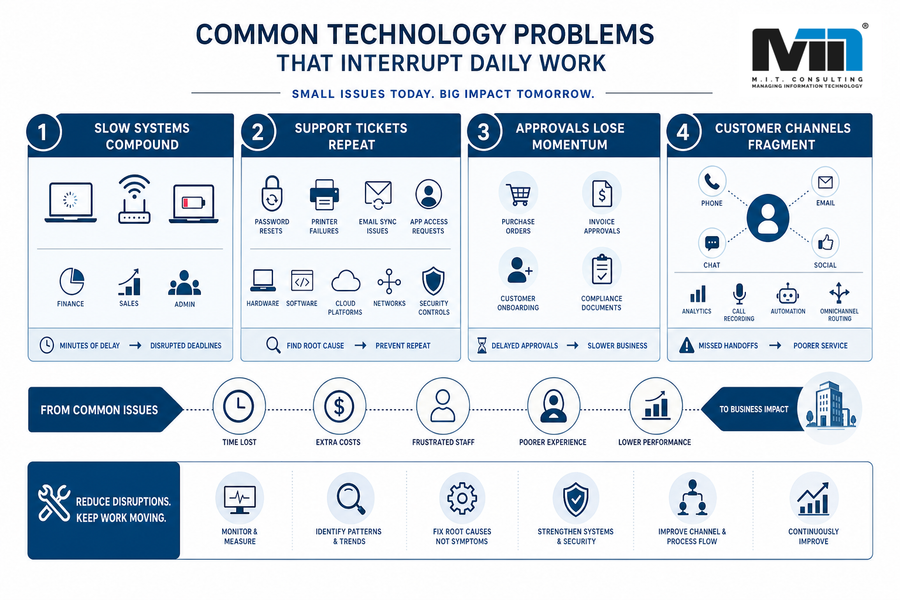
Slow systems compound: Lagging workstations, overloaded Wi-Fi, and aging laptops reduce throughput across finance, sales, and administration. A short delay opening a shared file becomes a reporting problem when several people depend on it.
-
Support tickets repeat: Password resets, printer failures, email sync issues, and access requests often point to root causes. A practical review looks across hardware, software, cloud platforms, networks, help desk patterns, and security controls together.
-
Approvals lose momentum: Poor reliability delays purchase orders, invoice approvals, onboarding, and compliance documentation. The business impact is felt by the person waiting to ship, bill, or close a file.
-
Customer channels fragment: Disconnected phone, email, chat, and social channels create missed follow-ups and inconsistent records. Contact center analytics, call recording, automation, and omnichannel routing help supervisors see where handoffs fail.
Technology Issues In Business And Their Operational Cost
Technology issues in business show up as downtime, duplicated work, slower customer response, audit gaps, and decisions made with incomplete information. Over 400 businesses trust M.I.T. Consulting for IT services because practical support has to connect day-to-day tickets with continuity, compliance readiness, and cost control.
-
Downtime blocks revenue activity Outages stop staff from processing orders, serving customers, accessing files, or using line-of-business applications. One report found median annual downtime from high-impact outages was 77 hours, which puts pressure on payroll, deadlines, and customer commitments.
-
Tickets reveal process gaps Recurring issues often signal unclear ownership, weak documentation, aging equipment, or limited user training. A weekly access ticket for the same accounting application becomes a management issue as much as a help desk issue.
-
Security risk spreads quietly Weak passwords, unpatched devices, unmanaged endpoints, and inconsistent backups complicate audits, insurance reviews, and recovery planning. Unit 42 reported that 86% of incidents it responded to in 2024 involved some sort of business-disrupting loss.
-
Customer experience becomes inconsistent Platform gaps lead to missed calls, duplicated notes, and incomplete customer records. Service quality drops when agents cannot see prior email, chat, and phone history together.
-
Leadership lacks reliable visibility Fragmented systems make budgeting, upgrade planning, and risk assessment harder. Strong advisory connects IT decisions to business outcomes using transparent recommendations that fit the organization.
Problems With IT Inside Growing Teams
Growth changes the shape of technology work. Adding users, locations, applications, shared mailboxes, and compliance obligations turns informal habits into problems with IT that affect scheduling, file access, customer records, and recovery planning. The cost of deferred decisions is real, with one analysis placing technical debt in the US at USD 1.52 trillion in 2022.
Specific Domain Scenario.A Toronto clinic adds practitioners, a second front desk queue, and more cloud-based patient documents. Staff share inbox access, use different devices, and rely on backups nobody has recently tested. When a laptop fails before a compliance documentation deadline, the issue is no longer a simple device replacement; it involves access control, records retention, vendor support, and patient communication.
This is where structured IT management becomes part of daily operations.
Help desk support, cybersecurity planning, cloud management, and contact center analytics give work clear ownership instead of leaving staff to rely on memory, informal passwords, or one person who knows how everything connects. M.I.T. Consulting can act as the IT department when there is no internal team, or co-manage alongside existing teams that need senior guidance, documentation, and vendor coordination.
Fix IT Problems Before They Grow
-
Types Of Managed Services That Reduce IT Risk And Daily Support Gaps
-
Managed Services Vs Professional Services: Plan IT Work Without Chaos
-
The Benefits Of IT Outsourcing: Better Control Over IT, Security, And Cost
-
Why Managed Services Matter When IT Starts Outgrowing Your Team
-
How To Choose a Managed Services Provider Without Adding IT Overhead
IT Problems In Business That Require A Structured Response
Moving from reactive support to a clearer operating model takes care because users are busy, budgets are limited, and systems are already in motion. IT problems in business need a sequence that protects daily work while reducing repeat effort.
Structured action reduces friction because staff know where to report issues, managers know which systems carry the most risk, and vendors know who owns each decision. It also prevents avoidable rework, such as replacing endpoints before confirming whether licensing, permissions, network capacity, or user training caused the issue. A practical approach recommends the right tier for the current stage of the business, with room to evolve as risk, headcount, and complexity change.
-
Review ticket patterns: Sort recurring support tickets by category, department, device, and application so repeated password resets, printer failures, or access requests can be traced to root causes.
-
Rank business systems: Identify platforms tied to revenue, customer service, invoicing, compliance, and approvals, then give them priority in support and recovery planning.
-
Document control points: Record backup, recovery, endpoint security, access control, and vendor ownership, especially since 48% of Windows users and 29% of macOS users encountered cyberthreats.
-
Set response expectations: Define help desk, onsite, emergency, and escalation paths so staff know what happens when a payroll laptop fails or a customer portal goes down.
-
Build a practical roadmap: Separate urgent fixes from planned improvements, with options that fit size, maturity, risk profile, and budget rather than pushing the most expensive path.
Stop Recurring IT Problems
Turn daily technology friction into a structured plan for stability, support, and risk reduction with M.I.T. Consulting.
Managing IT Problems With The Right Partner
When you review recurring tickets, slow approvals, customer communication gaps, and security concerns together, IT planning becomes easier to connect to business priorities. The goal is not to buy more tools; it is to identify root causes, reduce repeated interruptions, protect key systems, and make sure users can serve customers, process invoices, and recover files when something goes wrong.
M.I.T. Consulting is a 100% Canadian-owned, privately held partner that can act as your IT department or co-manage alongside an internal team, bringing responsive support, customized solutions, contact center capability, analytics, automation, cybersecurity planning, and senior-level guidance into one operating model. If you want a practical review of where technology is creating friction across invoices, approvals, customer communication, and recovery readiness, contact M.I.T. Consulting to map the next steps around reliability, cost control, and long-term continuity.